9 Presidents Who Screwed Up America: And Four Who Tried to Save Her by Brion McClanahan
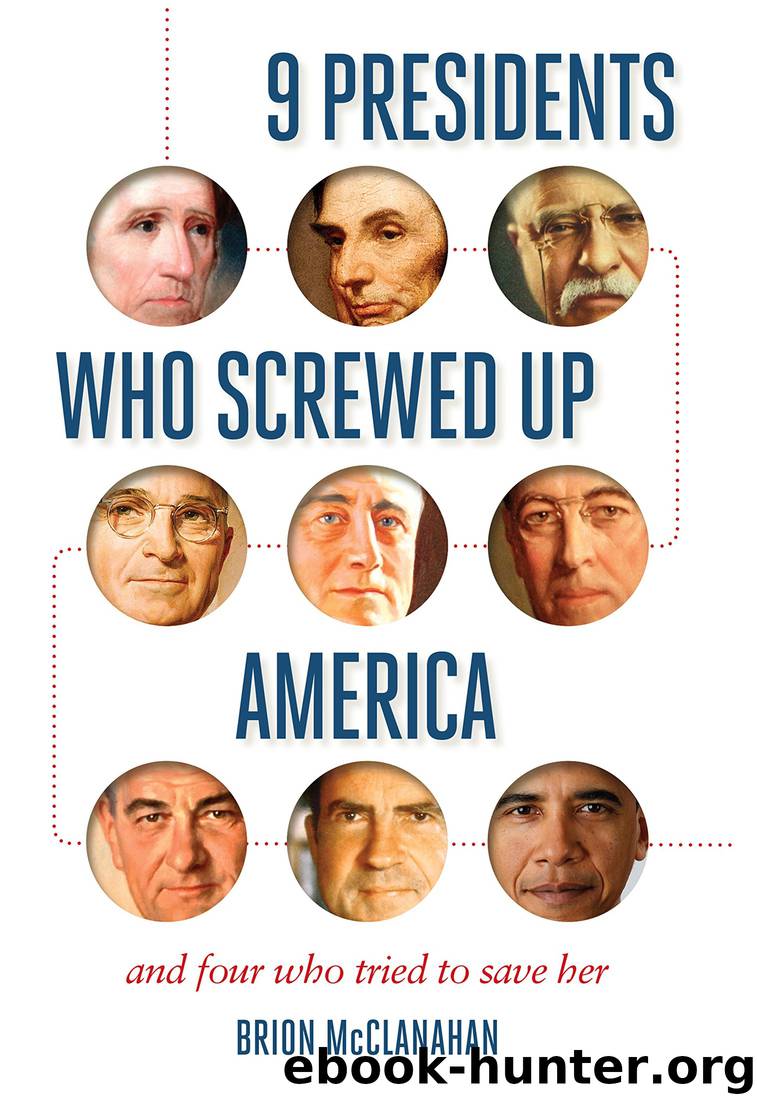
Author:Brion McClanahan [McClanahan, Brion]
Language: eng
Format: epub
Tags: History, United States, General, Biography & Autobiography, Presidents & Heads of State, Political Science, American Government, Executive Branch
ISBN: 9781621574910
Google: IBbfCgAAQBAJ
Amazon: B017QL99OI
Publisher: Regnery History
Published: 2016-02-08T00:00:00+00:00
THE NIXON SHOCK
Following World War II, the United States and its industrial Western allies had signed an agreement known as Bretton-Woods. It created the International Monetary Fund (IMF) and what eventually became the World Bank. The agreement also pegged international exchange rates to the United States dollar, which in turn was redeemable for gold and silver at a rate set by Congress. The United States promised not to devalue (inflate) its currency, and the other countries promised not to speculate in dollars or manipulate their currencies to gain a favorable exchange rate on the open market. The United States had the strongest economy in the world and as a result became the lender of first and last resort for industrial powers looking to rebuild after the most destructive war in human history.
But the United States quickly abandoned fiscal responsibility and began printing more greenbacks than it could redeem at the congressionally set price of gold and silver. The Marshall Plan dumped billions of dollars into Europe; the bursts of spending under the New Deal, Fair Deal, New Frontier, and Great Society doubled the federal budget, with the most dramatic expansion occurring under Lyndon Johnson; the Cold War ramped up American military spending; and the Vietnam War in particular forced the United States government to print more money to satisfy military contracts and foreign commitments to halt communist aggression in Asia and elsewhere. Employment was up, but a government-mandated minimum wage forced employers to pay higher wages and thus necessitated the need for more dollars. All this, coupled with government subsidies for agriculture, higher prices for oil and energy, and government money pumped into education and healthcare, created a currency crunch—or, more accurately, an inflation problem. Foreign powers soon realized that the United States might not be able to redeem their dollars, and so began demanding gold.
The situation became acute in the administration of John Kennedy, but neither he nor Johnson could see that cutting spending both at home and abroad might force dollars out of circulation and thus reduce the crisis. By 1971, Nixon realized that something had to be done to solve the problem, but his answer to the crisis, like many other actions during his administration, was an unconstitutional one.
In August 1971 Nixon summoned his top economic advisors to Camp David to discuss the situation. The course of action he decided on involved tax cuts and spending cuts and a price-and-wage freeze for ninety days, along with a suspension of the dollar-to-gold convertibility—in essence a unilateral dissolution of the Bretton-Woods agreement. Nixon presented his “New Economic Policy” to the American people on August 15, 1971, in a televised address. Nixon argued that he had the legal authority to act independently because of the Economic Stabilization Act of 1970, a bill he had signed into law. In that Act, Congress had given the president wide-ranging authority to “stabilize” the economy in the event of a crisis. But they had no constitutional authority to do so. The Congress cannot delegate legislative functions to the executive office.
Download
This site does not store any files on its server. We only index and link to content provided by other sites. Please contact the content providers to delete copyright contents if any and email us, we'll remove relevant links or contents immediately.
Waking Up in Heaven: A True Story of Brokenness, Heaven, and Life Again by McVea Crystal & Tresniowski Alex(37876)
Empire of the Sikhs by Patwant Singh(23140)
We're Going to Need More Wine by Gabrielle Union(19111)
Hans Sturm: A Soldier's Odyssey on the Eastern Front by Gordon Williamson(18653)
Leonardo da Vinci by Walter Isaacson(13414)
The Radium Girls by Kate Moore(12097)
Tools of Titans by Timothy Ferriss(8502)
Educated by Tara Westover(8120)
How to Be a Bawse: A Guide to Conquering Life by Lilly Singh(7551)
Permanent Record by Edward Snowden(5908)
The Last Black Unicorn by Tiffany Haddish(5687)
The Rise and Fall of Senator Joe McCarthy by James Cross Giblin(5319)
Promise Me, Dad by Joe Biden(5193)
The Wind in My Hair by Masih Alinejad(5142)
A Higher Loyalty: Truth, Lies, and Leadership by James Comey(5021)
The Crown by Robert Lacey(4870)
The Iron Duke by The Iron Duke(4411)
Joan of Arc by Mary Gordon(4160)
Stalin by Stephen Kotkin(4010)
